


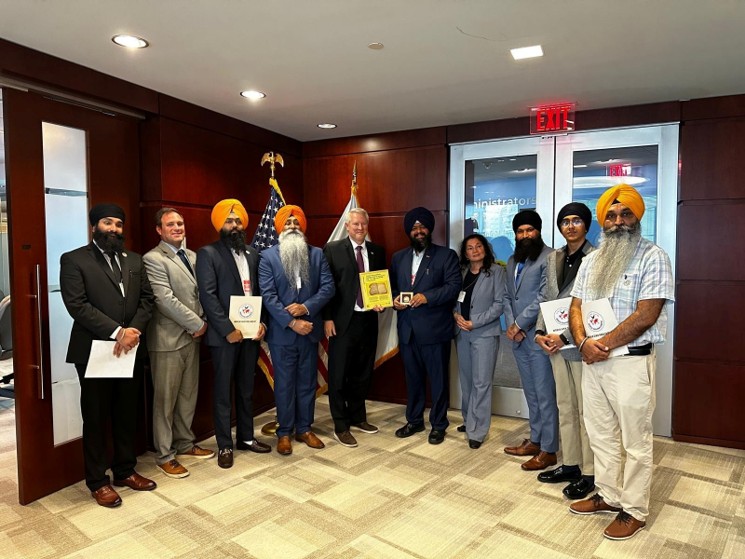
UNITED SIKHS and Sikh Community Stakeholders Address 2026 CDL Regulations with FMCSA Leadership
Washington, D.C.
July 10, 2026
On July 9, 2026, UNITED SIKHS and Sikh community leaders met with officials from the Federal Motor Carrier Safety Administration (FMCSA) to discuss concerns regarding the implementation of the FMCSA’s 2026 Commercial Driver’s License (CDL) regulations. The meeting included Ryan M. Snyder, Director of Government Affairs, and Phillip W. Thomas, Deputy Assistant Administrator for the Office of Safety. It focused on the implementation of the FMCSA’s Final Rule, “Restoring Integrity to the Issuance of Non-Domiciled Commercial Driver’s Licenses (CDLs).”
Sikh Historical Role in the U.S. Transportation Industry
The meeting opened with remarks recognizing the Sikh community’s long-standing contributions to the American trucking and transportation industries. Participants discussed the community’s decades of service as commercial drivers, owner-operators, and small business owners who play a vital role in the nation’s supply chain. The discussion included an historical overture describing the Sikh community’s history and exodus from Punjab, India to work in the transportation industry in the United States, beginning in the late 1800s and again following the 1984 mass persecution of Sikhs in India.
The Rule’s Impact on Thousands of Legally Present Commercial Drivers
During the meeting, UNITED SIKHS and the entire delegation expressed concern that implementation of the FMCSA rule barring immigrants, which became legally effective on March 16, 2026, has resulted in thousands of legally present commercial drivers being unable to obtain or renew their CDLs. Beginning in November and December 2025, following a similar FMCSA interim rule issued in September 2025, state Departments of Motor Vehicles (DMVs) began abruptly effectuating cancellations and confiscating CDLs for non-domiciled drivers without due process.
The delegation emphasized that many affected drivers have maintained exemplary safety records and relied upon their commercial licenses for years to support their families. Many drivers have experienced the loss of employment without sufficient notice, meaningful transition procedures, or an individualized opportunity to demonstrate their lawful status, possible licensing eligibility, or driving history. The Sikh stakeholders emphasized that highway safety is best advanced by evaluating objective safety performance.
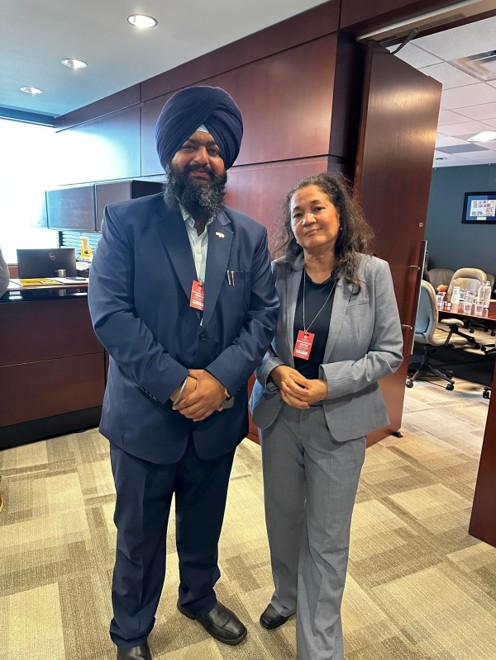
In photo: The Honorable Mayor Swarnjit Singh of Norwich, Connecticut together with UNITED SIKHS Chief Legal Officer and National Legal Director, Wanda Sanchez Day, Esq.
Community Impact of the FMCSA Rule
At the meeting, stakeholders and UNITED SIKHS further stated that the effects of the new FMCSA rule extend beyond individual drivers and have broader implications for the national economy. The organization noted that commercial transportation depends upon a stable workforce of qualified drivers and that reductions in that workforce may contribute to supply chain disruptions, increased transportation costs, higher insurance expenses, financial strain on owner-operators and small trucking companies, and increased risk to lenders that finance commercial vehicles.
Resolving Anti-Immigrant Rhetoric
The stakeholders also urged FMCSA to issue a public statement rejecting rhetoric that attributes heightened roadway safety risks to immigrant commercial drivers based on their immigration status or other demographic characteristics. They further requested that the agency reaffirm that its safety mission will be guided by objective performance data and evidence-based safety standards, and that FMCSA evaluates drivers and motor carriers based on measurable safety indicators, not immigration status, ethnicity, or other demographic characteristics.
English Language Enforcement Duplication
Additionally, stakeholders emphasized, and the FMCSA agreed, that federal law requires commercial drivers to understand official traffic signs, communicate with law enforcement, respond to official inquiries, and complete required reports. However, the regulations do not require native-level English proficiency.
The organizations expressed concern that subjective roadside assessments by untrained inspectors may produce inconsistent enforcement and duplicate evaluations already conducted by State Licensing Agencies during the CDL testing process.
FMCSA officials indicated during the meeting that they were not seeing widespread examples of such cases and noted that procedural safeguards exist within the enforcement system.
Continuing Dialogue
The meeting concluded with a mutual commitment to continued engagement. FMCSA officials acknowledged the concerns presented, and stakeholders and UNITED SIKHS committed to providing additional information and documentation in support of their recommendations.
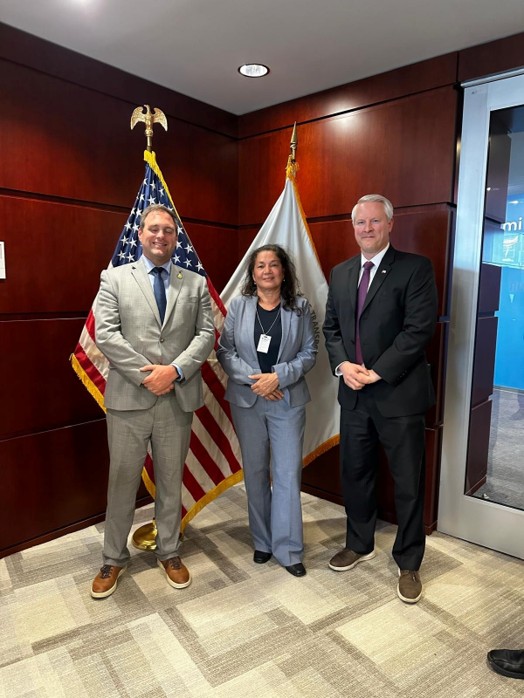
UNITED SIKHS Chief Legal Officer and National Legal Director Wanda Sanchez Day, Esq. together with FMCSA Officials Ryan M. Snyder, Director of Government Affairs, and Phillip W. Thomas, Deputy Assistant Administrator for the Office of Safety
UNITED SIKHS Follow-Up Communications to FMCSA Individualized State Interpretations of the 2026 Rule Undermine the FMCSA’s Uniformity Objectives
In its follow-up letter to FMCSA officials on July 13, 2026, UNITED SIKHS reiterated the above mentioned concerns and cited examples of states misinterpreting federal regulations. For example, the California Department of Motor Vehicles (DMV) has a policy of rejecting the USCIS-issued Form I-797, Notice of Action, which extends the validity of Permanent Resident Cards (“green cards”), as acceptable proof of lawful presence for obtaining a CDL.
These interpretations undermine FMCSA’s objective of establishing a uniform national framework for commercial driver’s license (CDL) issuance and may result in otherwise qualified lawful permanent residents being denied CDLs or prevented from renewing their commercial licenses.
The organization urged FMCSA to issue clearer written guidance identifying the immigration documents that State Driver Licensing Agencies (SDLAs) must accept as proof of lawful presence to ensure consistent implementation of federal CDL requirements and lawful recognition of USCIS’s authority over immigration matters nationwide.
Federal Uniformity and Preemption
UNITED SIKHS also expressed in its communications concern that recently enacted state legislation and varying local policies on the CDL issue have created inconsistent CDL eligibility standards across the country.
UNITED SIKHS requested that FMCSA exercise its federal authority and issue guidance confirming that the federal CDL regulatory framework governs nationwide commercial driver licensing and clarifying that state or local legislation is preempted under federal law.
According to the organization, such action would promote FMCSA’s goal of achieving nationwide consistency, reduce regulatory uncertainty, and support interstate commerce.
Addressing Due Process Concerns
UNITED SIKHS also urged FMCSA to adopt uniform due process protections following the CDL cancellations caused by the FMCSA interim and final rules.
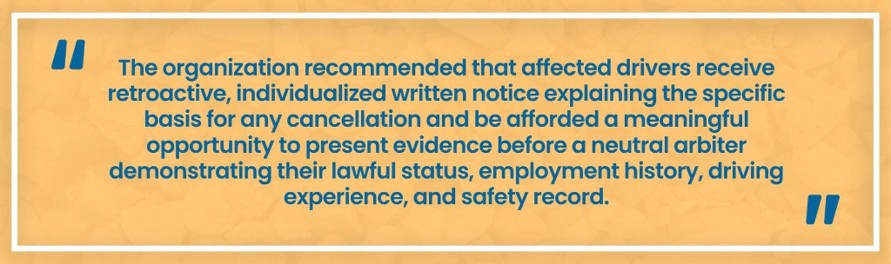
The organization urged FMCSA to ensure that this practice is followed before any driver loses CDL privileges in the future.
UNITED SIKHS stated that individualized review would better balance highway safety objectives with principles of fairness and administrative consistency across states.
Recommendations Submitted to FMCSA
In its July 10 letter, UNITED SIKHS presented the following recommendations to the FMCSA administration:
- Suspend CDL cancellations affecting drivers holding unexpired licenses issued before March 16, 2026, pending individualized due process review.
- Clarify acceptable documentation standards and direct State Driver Licensing Agencies to recognize valid USCIS documentation demonstrating continuing lawful status and employment authorization, including qualifying Form I-797 Notices of Action as proof of lawful presence.
- Conduct a transparent, evidence-based analysis of the 2026 Rule’s workforce, economic, and highway safety impacts before expanding or continuing implementation of the rule.
- Issue nationwide uniform application procedures that states must follow to ensure consistent application of CDL eligibility standards.
- Exercise federal preemption authority to address state and local CDL legislation that could undermine nationwide uniformity.
- Publicly reaffirm that FMCSA safety policy is based on objective safety performance and that the agency has not identified empirical evidence linking immigration status or national origin to increased highway safety risks.
WE RECOGNIZE THE HUMAN RACE AS ONE.