
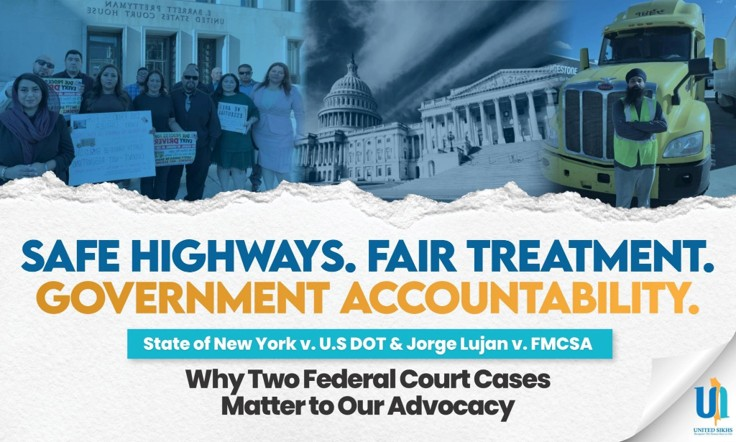
UNITED SIKHS: Second Circuit Ruling and Lujan Litigation Raise Issues That Matter to All Americans — From Safe Highways to Fair Treatment and Government Accountability
NEW YORK — November 21, 2026 — UNITED SIKHS is proud to have served as a signatory to amicus curiae briefs in both State of New York v. U.S. Department of Transportation, No. 26-1097 (2d Cir.), and Lujan v. Federal Motor Carrier Safety Administration, No. 26-1032 (D.C. Cir.). Through its participation, UNITED SIKHS stands alongside a broad number of civil rights organizations, immigrant advocacy groups, labor unions, and community leaders working to protect commercial drivers’ rights and livelihoods and ensure that government agencies act within the law.
UNITED SIKHS extends its sincere gratitude to the State of New York and the New York State Department of Motor Vehicles for bringing the Second Circuit challenge, and to the American Federation of State, County and Municipal Employees (AFSCME) and the American Federation of Teachers (AFT) for bringing the Lujan litigation.
We especially recognize the leadership of the Asian Law Caucus and the Sikh Coalition, and all the organizations that joined these efforts as signatories and amici curiae. Their contributions and legal arguments are reflected in the briefs filed with the respective federal appellate courts:
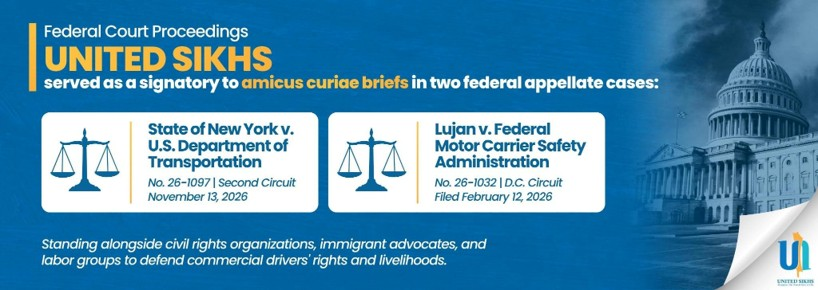
Second Circuit: Amici Curiae Brief of Immigrant and Workers Rights Advocates in Support of Petitioners, State of New York v. U.S. Department of Transportation, No. 26-1097 (2d Cir. July 13, 2026).
D.C. Circuit: Brief of The Sikh Coalition et al. as Amici Curiae in Support of Petitioners, Lujan v. Federal Motor Carrier Safety Administration, Docket No. 2179915, No. 26-1032 (D.C. Cir. June 22, 2026).
We are equally grateful to the labor organizations, state and local governments, elected officials, and other public entities that have supported these legal efforts through their participation and amicus submissions.
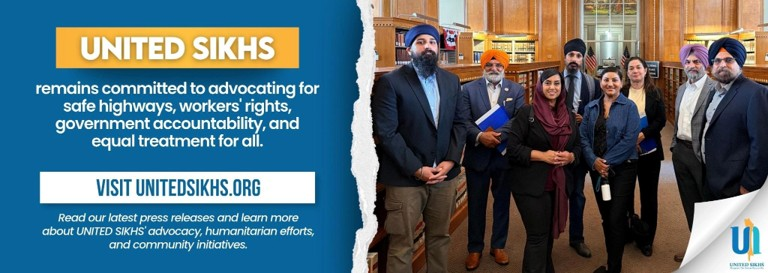
UNITED SIKHS is honored to partner with these organizations and entities and lend its voice, resources, and support to their collective efforts to advance civil rights, protect working families, and secure equal treatment under the law for all people.
Public Safety, Workers’ Rights, and Civil Rights Protect Everyone
Although the two cases involve separate legal proceedings, both concern federal regulatory actions affecting non-domiciled Commercial Driver’s License (CDL) holders and raise important questions about federal authority, government accountability, and the rights and livelihoods of working people.
The Second Circuit’s November 13, 2026 decision in State of New York v. U.S. Department of Transportation ruled in New York’s favor, setting aside FMCSA’s determination concerning the state’s CDL program and the federal government’s threatened withholding of highway funding. The court concluded that the regulations in effect during the relevant period did not contain the expiration-date matching requirement asserted by the agency.
The Lujan litigation challenges federal regulatory actions affecting non-domiciled CDL holders and their ability to continue working. The case remains undecided before the D.C. Circuit.
UNITED SIKHS Brings Truck Drivers to Court in Solidarity with Lujan Legal Team Beyond its participation in the amicus briefs, UNITED SIKHS has worked to ensure that the voices of commercial drivers are present and heard in the pursuit of justice.
UNITED SIKHS organized and on September 15, 2026 joined truck drivers and advocates from across the country in the courtroom during the Lujan legal arguments. The truckers’ presence represented more than support for a particular lawsuit; it demonstrated the real human impact of federal CDL policies on the livelihoods, families, and futures of working drivers.
The drivers’ participation reflected a powerful message of unity: those whose lives are affected by these policies deserve to have their voices represented in the legal process.
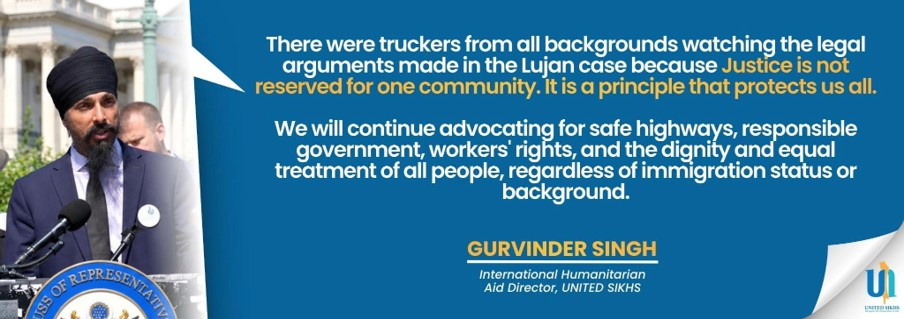
A Shared Commitment to Justice
UNITED SIKHS believes that public safety and civil rights are complementary, not competing, interests. Safe highways require sound regulations, responsible enforcement, and effective use of taxpayer resources. Equally important, policies affecting people’s ability to work must be lawful, fair, and respectful of their dignity and rights.
Commercial drivers are essential to America’s economy and supply chains. Policies affecting their livelihoods impact not only individual workers and their families but also businesses and communities nationwide.
These cases demonstrate why government accountability and independent judicial oversight matter. Federal agencies must exercise their authority lawfully and ensure that their decisions are supported by the governing law.
Related Post
UNITED SIKHS Takes Initiative to Build Protective Embankments Along Sutlej River in Panjab
UNITED SIKHS Takes Initiative to Build Protective Embankments Along Sutlej River in Panjab Service Campaign Launched to Protect Villages and…
UNITED SIKHS Launches Malaysian Flood Relief Programme DONATE NOW: Floods Cause Death & Destruction in Malaysia. Emergency Supplies Urgently Needed.
UNITED SIKHS base camp set up in Sikh Gurdwara in Muar to provide supplies to nearby relief centres We Need…