

UNITED SIKHS Filed Statement in Multi-Organization Amicus Brief Supporting Commercial Drivers in Lujan Case
The organizations urged the Court to vacate the Federal Motor Carrier (FMCSA) rule that threatens the livelihoods of lawful, employment authorized commercial drivers based on unsupported assumptions based on immigration status.
UNITED SIKHS is an international humanitarian-aid and civil and human-rights advocacy organization based in New York. It supported the filing of an amicus curiae brief in the Lujan case urging the Court to grant the petitions for review and vacate the challenged rule affecting commercial drivers.
For more than two decades, UNITED SIKHS has worked to protect civil liberties and provide legal services, policy advocacy, and community support to individuals and families throughout the United States. The organization has served thousands of members of the Sikh community, many of whom are essential participants in the transportation and trucking industries.
In its amicus brief, UNITED SIKHS explains that the challenged rule has caused serious and unjustified harm to commercial drivers who are lawfully authorized to live and work in the United States. The organization has worked directly with drivers affected by the rule and has seen how the loss of commercial driving eligibility destabilizes households, deprives families of needed income, and places U.S.-citizen children and spouses at risk.
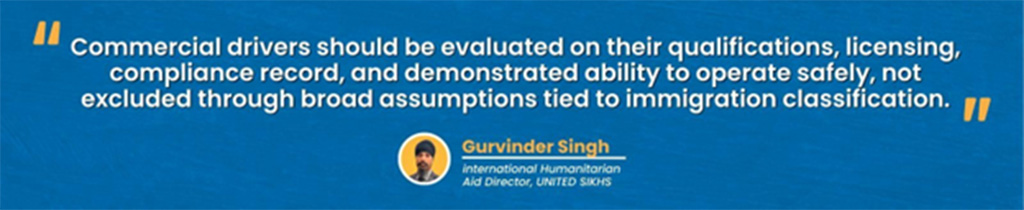
“The drivers impacted by this rule have built their careers and families in the United States. They have maintained required licenses, complied with state and federal regulations, and contributed substantially to the nation’s economy and supply chain,” Gurvinder added.
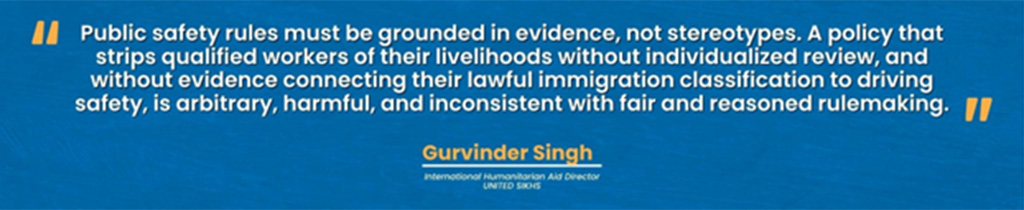
UNITED SIKHS, like the plaintiffs, argues that there is no rational or evidence-based connection between a driver’s immigration classification and that individual’s ability to safely operate a commercial vehicle. The affected drivers have completed licensing requirements, maintained safe driving records, and met applicable regulatory obligations. Yet, under the challenged rule, otherwise qualified drivers have lost their ability to work without meaningful notice, an individualized assessment of their qualifications, or an adequate opportunity to contest the deprivation.
The brief further contends that the agency failed to provide empirical evidence or a reasoned explanation showing that the targeted immigration classifications present a legitimate highway-safety concern. Instead, the rule relies on categorical assumptions that recent lawful arrivals are less safe drivers solely because of their immigration status.
UNITED SIKHS respectfully asks the Court to vacate the challenged rule. The organization’s statement supports the Petitioners’ position that the rule unjustifiably excludes qualified commercial drivers, lacks a rational connection to any legitimate safety objective, and inflicts far-reaching harm on workers, families, communities, and the transportation sector.